Written Code of Ethics for University Leaders, Academic Staff, Administrative Staff, and Students
University of Phayao is deeply committed to embedding integrity, transparency, and ethical conduct into its institutional culture. To ensure high standards of governance, the university has established and enforced a comprehensive, Written Code of Ethics that strictly applies to all core sectors of the university community, categorized into four distinct groups as follows:University Leaders
For University Leaders, the code strictly dictates that members of the University Council, the President, Vice Presidents, and Deans must demonstrate ethical leadership. This includes integrating environmental sustainability into the university's strategic plans, ensuring transparent budget allocation for green initiatives, and maintaining high accountability in institutional decision-making. Their compliance is assessed annually through the Integrity and Transparency Assessment (ITA), reinforcing a culture of clean and green governance.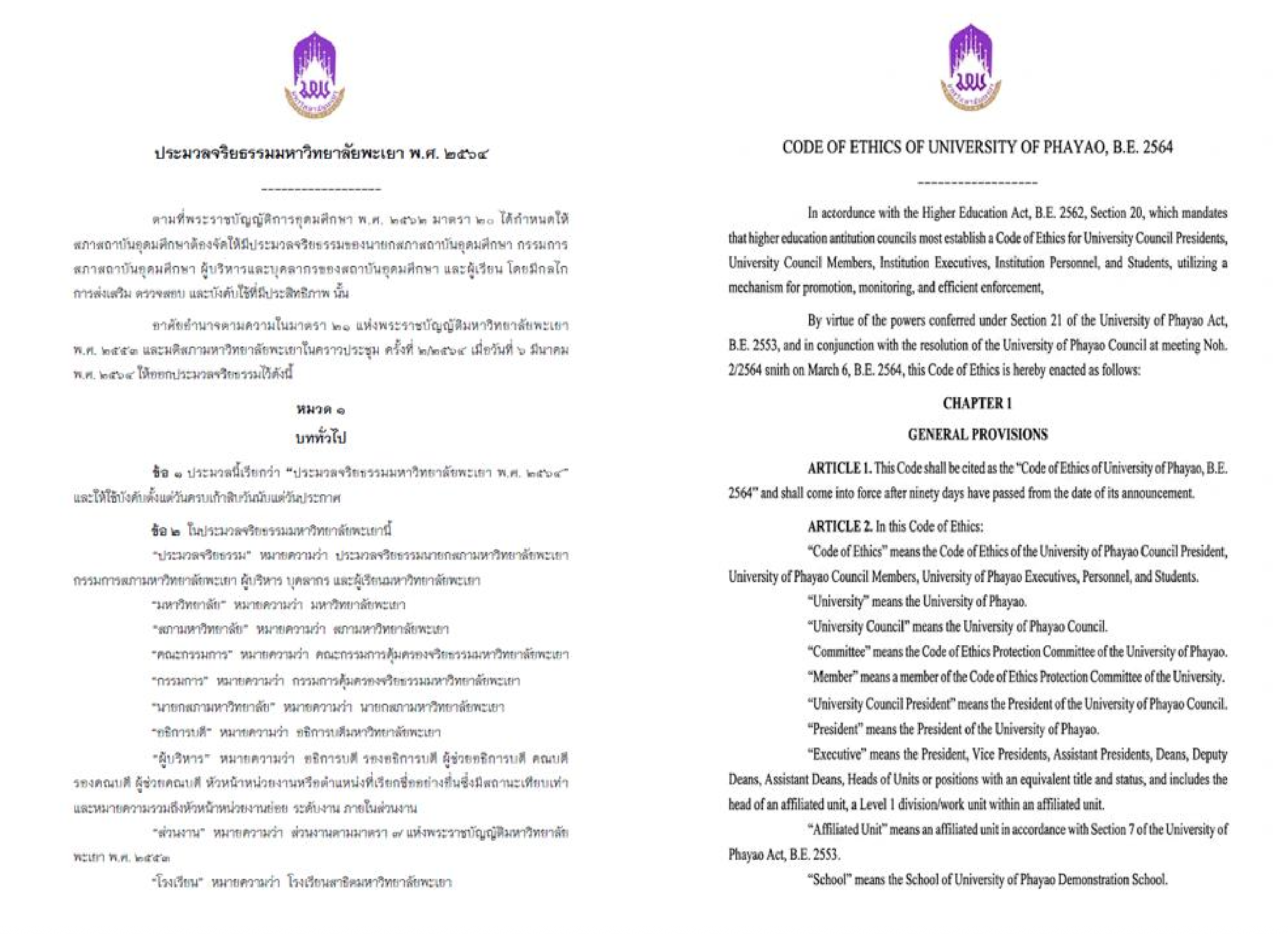
Code of Ethics, University of Phayao, 2021
Academic Staff and Administrative Staff
Academic Staff (School Members): Guided by the Code of Conduct for University Personnel, ensuring teaching excellence, research integrity, and professional ethics toward students and society.Administrative Staff (Support Personnel): Aligned with the same Code of Conduct, focusing on public service efficiency, honesty, and non-discriminatory assistance.
Academic Staff and support personnel are aligned under the same ethical framework, ensuring that campus operations are run with high efficiency, transparency, and accountability. Staff members are committed to providing public services honestly, reducing resource consumption in offices, and offering non-discriminatory assistance to all students, visitors, and stakeholders, fostering an inclusive and eco-friendly campus community.
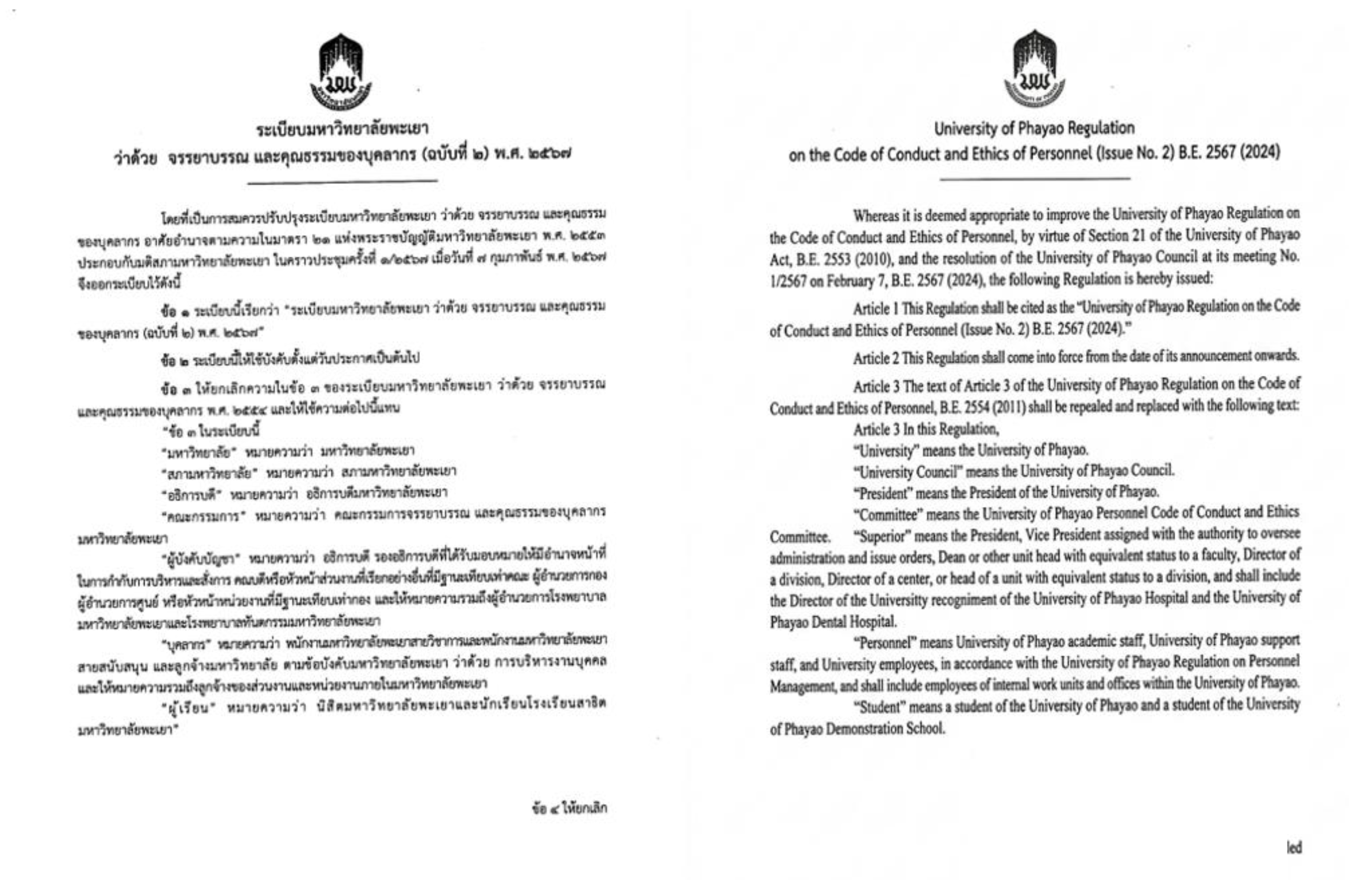
University of Phayao Regulations on the Code of Conduct and Morality of Personnel (Edition 2), 2024, announced on March 12, 2024.
Students
For the student body, ethical standards and behavioral expectations are formally enforced through the University of Phayao Regulation on Student Discipline and communicated widely via the annual Student Handbook. The university actively promotes "Academic Honesty" by enforcing strict anti-cheating and anti-plagiarism policies. Furthermore, "Civic Responsibility" is cultivated by encouraging students to participate in eco-friendly campus initiatives, such as waste segregation, plastic reduction, and campus road safety compliance. Lastly, the codes foster "Respectful Campus Coexistence," ensuring a safe, inclusive, and non-discriminatory environment that respects diversity and human dignity for all students.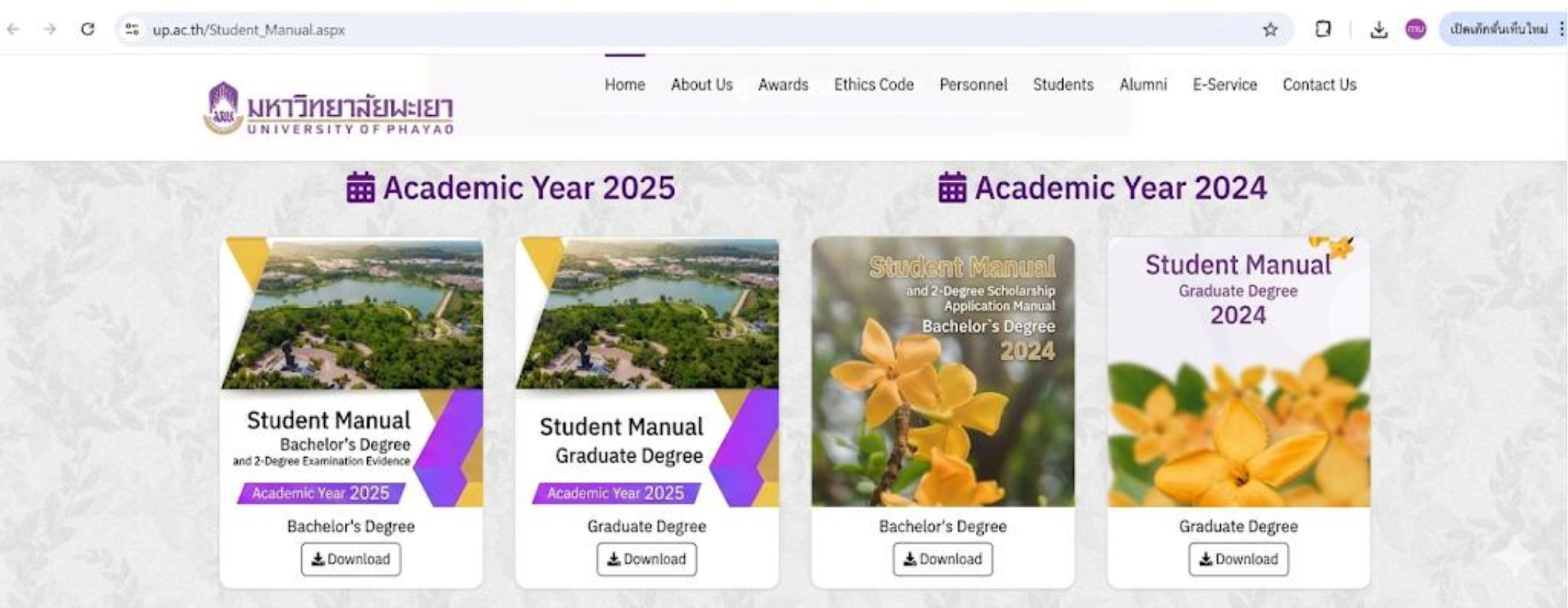
University of Phayao Student Handbook (Bachelor's, Master's, and Doctoral Degrees)
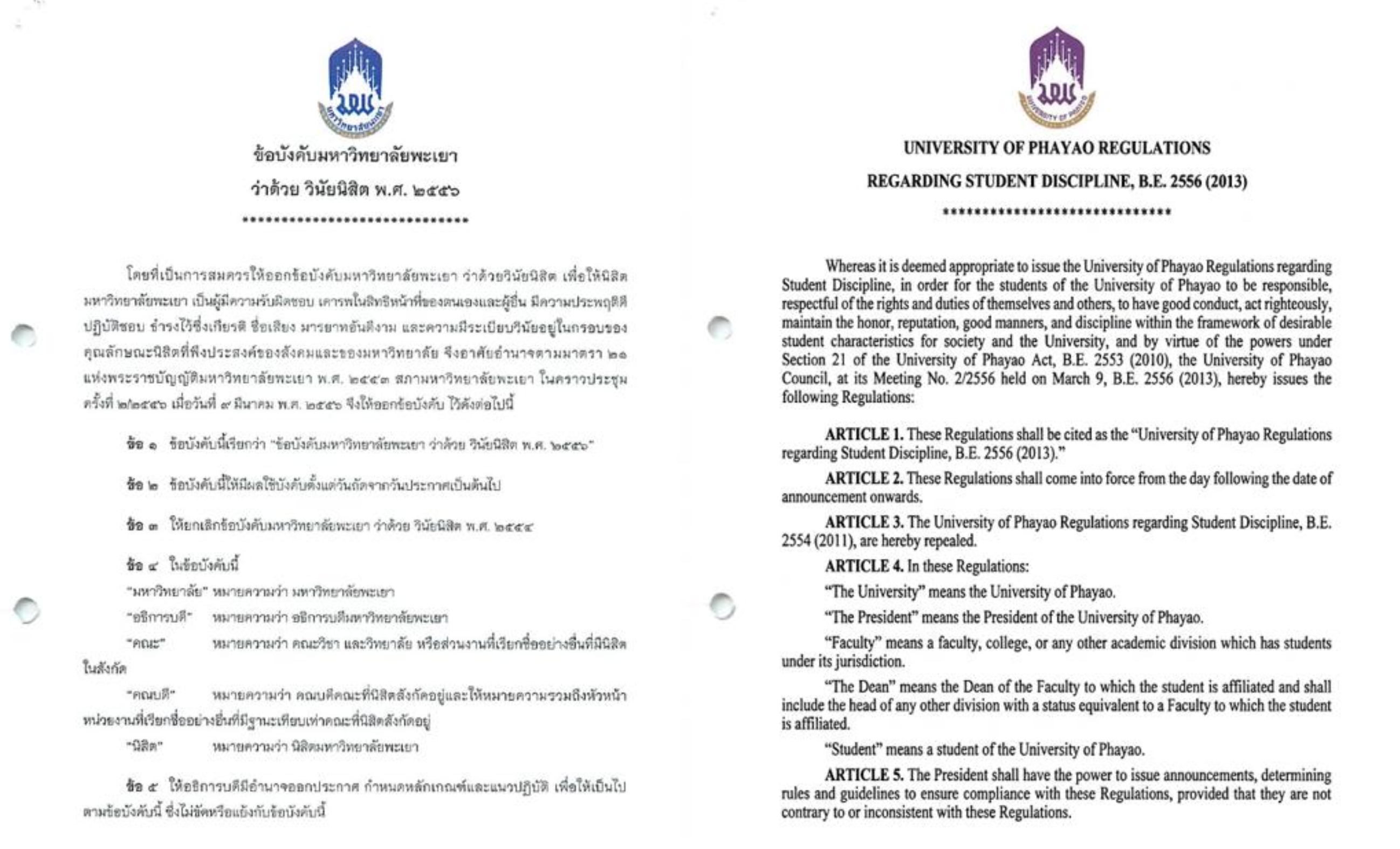
University of Phayao Regulations on Student Discipline, 2013.
Table for compiling written evidence of professional ethics.| Target Group | Document Title | Recommended Source / URL Placement |
|---|---|---|
| Leaders / Staff | University of Phayao Regulation on the Code of Ethics | https://up.ac.th/Ethics-Code.aspx |
| Academic & Admin | Code of Conduct for University Personnel | https://www.lp.up.ac.th/FileUpload/Doc/2567/D10/d751.pdf |
| Students | Student Disciplinary Regulations & Handbook |
https://www.lp.up.ac.th/FileUpload/Doc/2563/D15/D371.pdf https://addnews.up.ac.th/PDF-Flip/pdf_read.aspx?itemID=11039 https://addnews.up.ac.th/PDF-Flip/pdf_read.aspx?itemID=11040 |