University of Phayao takes knowledge from research and education into real practice to conserve, restore, and manage terrestrial ecosystems, covering forest conservation, soil restoration, protection of threatened species, sustainable agricultural land management, and building cooperation with communities to care for natural resources.
- Restoring Forests, Soil, and Ecosystems Together with Communities
In 2025, the School of Science carried out a project to restore and conserve forest ecosystems in the area bordering the university, conservation forest areas, and the Ban So community forest in Phayao Province, under the “1 School 1 SDG” project, to address the accumulation and burning of leaves and biomass in the dry season, one cause of PM2.5 pollution and soil degradation.
The university worked with the community to reuse biomass materials by establishing 30 compost pits, using leaves, straw, banana stems, and cow manure to produce organic fertilizer, helping reduce burning, increase soil organic matter, and cut costs by about 2,500 baht per pit, while also expanding into straw mushroom cultivation, keeping stingless bees, and processing honey and beeswax, to generate income alongside increasing pollinator populations and supporting biodiversity.
A project to develop community leaders to transfer knowledge to 10 villages led to community participation in reducing burning, lowering forest fire risk, restoring soil quality, and sustainably managing forest resources, achieving a Social Return on Investment (SROI) of 4.23 times – meaning every 1 baht invested created about 4.23 baht of social, economic, and environmental value within one year.
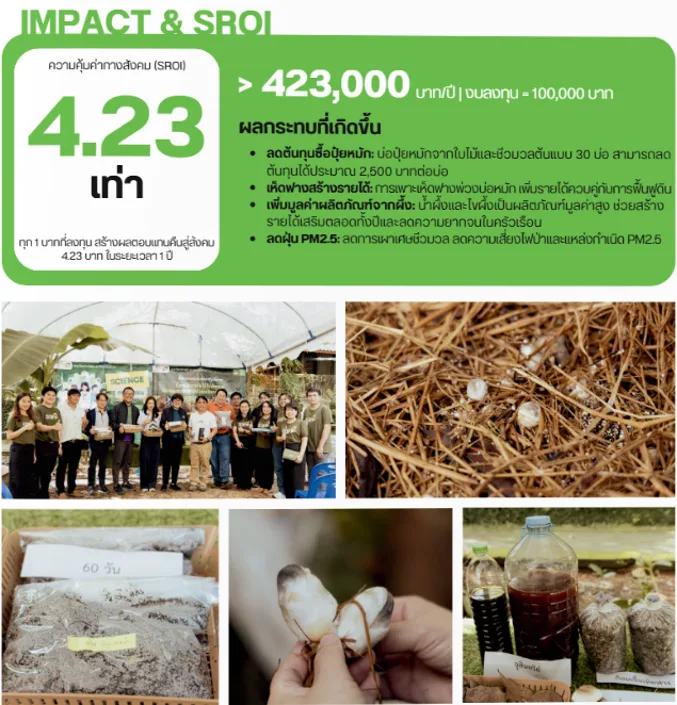
Figure : The forest ecosystem restoration and conservation project
At the institutional level, the university also holds the annual National Tree-Loving Day, with students and staff planting more than 550 conservation tree species to increase green space and build participation in forest resource conservation.
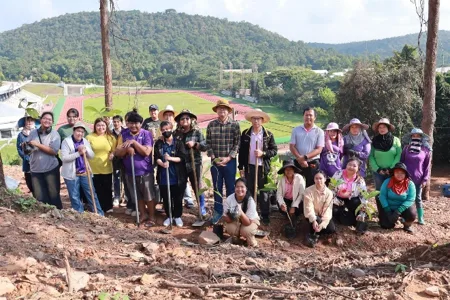
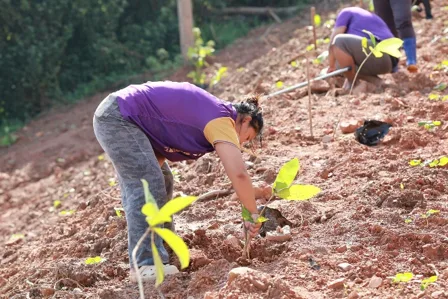
Figure : Students and staff planting conservation tree species