Overview
The University of Phayao is home to one of the most comprehensive groups of health science faculties in Upper Northern Thailand. Working closely with the University of Phayao Hospital, the university provides healthcare services to local communities while producing healthcare professionals who serve rural and underserved areas across Northern Thailand.
Policies and Plans
- Safety Policy covering laboratory safety, food safety, COVID-19 prevention, and PM2.5 air quality management.
- Community Track Medical Education Programme implemented in collaboration with the Ministry of Public Health to increase the distribution of physicians throughout Northern Thailand.
Implementation
University of Phayao Hospital
- General enquiries: +66 54 466 666 ext. 7000. Outpatient services are available Monday–Friday, 08:00–16:00.
- Emergency Department: +66 54 466 758, available 24 hours a day, seven days a week.
- The hospital operates under the School of Medicine following organizational restructuring in 2020.
Dental Hospital
- Provides comprehensive dental services for students, university personnel, and the general public.
Six Health Science Faculties
- School of Medicine.
- School of Dentistry.
- School of Pharmaceutical Sciences.
- School of Nursing — including the Community-Based Nursing Education Programme.
- School of Public Health.
- School of Medical Sciences.
Environmental and Health Monitoring Systems
- Real-time PM2.5 air quality monitoring system operated by the Center of Environment and Sustainable Management (CESM).
- COVID-19 and PM2.5 information platform available through the university sustainability website.
Clinical Medical Education Center
- Operated in collaboration with Phayao Hospital as a joint institution for medical education and physician training.
Developing Health Professionals and Strengthening Health Systems through Community Engagement
The University of Phayao is committed to improving the health and well-being of the population through an integrated approach that connects health workforce development, research, healthcare services, academic outreach, and partnerships with stakeholders at multiple levels.
As a university serving Northern Thailand, the University recognizes that developing a strong health workforce is a fundamental foundation for strengthening the regional health system, while also helping to reduce health inequalities among vulnerable populations.
Developing the Health Workforce of the Future
The University of Phayao has seven health sciences faculties: the School of Medicine, School of Dentistry, School of Nursing, School of Pharmaceutical Sciences, School of Medical Sciences, School of Allied Health Sciences, and School of Public Health.
Together, these faculties educate and develop health professionals equipped to respond to the continuously evolving needs of Thailand’s healthcare system.
In 2025, the University produced 1,459 health sciences graduates out of a total of 5,233 graduates, representing 27.88% of all graduates. This contributes to expanding the health workforce needed to support the delivery of healthcare services in hospitals and communities.
These graduates include physicians, dentists, nurses, pharmacists, medical technologists, physical therapists, public health professionals, and other healthcare professionals working in hospitals, communities, and public health agencies across the country.
However, the University recognizes that producing graduates alone is not sufficient. It therefore emphasizes community-based learning, interdisciplinary learning, research, and academic outreach, enabling students to learn from real-world situations and develop the capacity to address community health challenges before graduation.
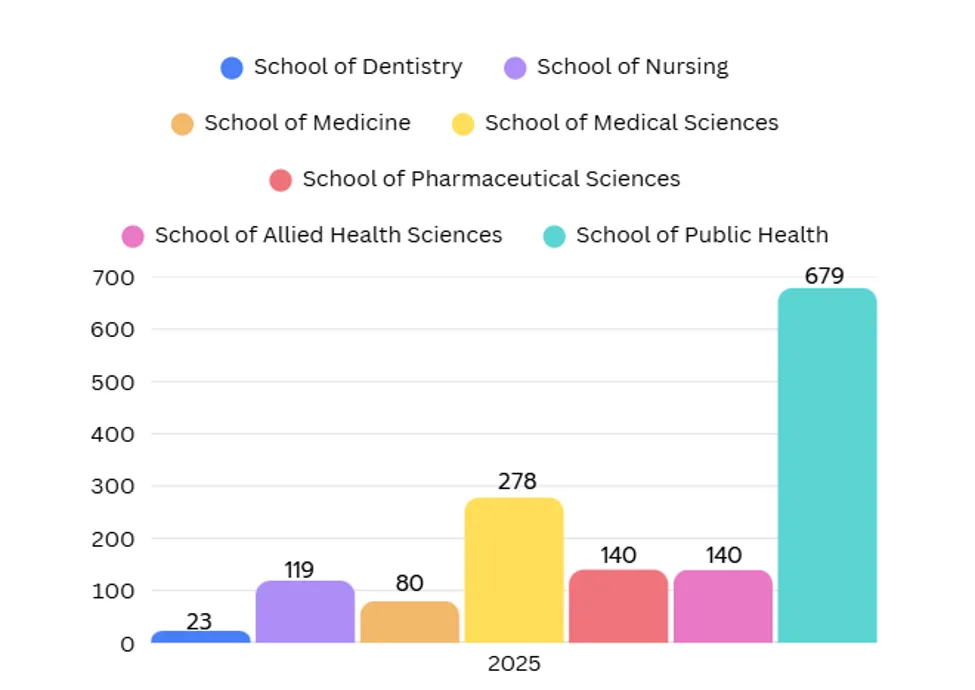
Figure : Number of Health Sciences Graduates
Creating Sustainable Health Impact
The University of Phayao’s approach demonstrates that improving the health and well-being of the population cannot rely solely on healthcare treatment. Instead, it requires an integrated approach that brings together health workforce development, research, partnerships, academic outreach, preventive health promotion, and community engagement.
Through this integrated approach, the University is able to develop the next generation of health professionals while simultaneously addressing real-world health challenges in local communities. These efforts help reduce health inequalities, strengthen health systems, and improve the quality of life of both students and the wider population.
This approach directly contributes to SDG 3: Good Health and Well-being, while also creating strong linkages with SDG 4: Quality Education, SDG 10: Reduced Inequalities, and SDG 17: Partnerships for the Goals, demonstrating how collaborative and community-based action can generate tangible and sustainable development outcomes.
THE Impact Rankings – SDG 3
| Year | Thailand Rank | World Rank | Source |
|---|---|---|---|
| 2023 | 10 | 401–600 | up.ac.th |
| 2022 | 6 | 201–300 | thaipr.net |
| 2021 | 5 | 301–400 | up.ac.th |
 ← SDG 2: Zero Hunger